
Bathroom Wall Panelling vs Tiles: Which Is Best for Your Bathroom?
When you're planning a bathroom renovation, there are plenty of decisions to make…
Which shower should you choose? Do you want a bath? What type of flooring will work best? How much storage do you need?
And then there's another decision that can have a surprisingly big impact on the finished room:
Should you choose bathroom wall panelling or traditional tiles?
Tiles have been the go-to choice for bathrooms for generations, and for good reason. They're durable, versatile and available in an enormous range of colours, sizes, patterns and finishes.
But bathroom wall panelling has become increasingly popular too.
Modern bathroom panels can provide a clean, contemporary finish, with fewer visible joints and a huge range of styles. From simple plain colours to marble effects and realistic wood finishes, there's now far more choice than there used to be.
So, which is actually best?
The honest answer is that there isn't one option that's right for every bathroom.
It comes down to the size of your room, your budget, how much maintenance you're happy with and, perhaps most importantly, the look you want to achieve.
If you're considering a bathroom renovation in Bristol, it's worth understanding the differences before you decide which finish is right for your room.
What Is Bathroom Wall Panelling?
Bathroom wall panelling is designed to provide a water-resistant wall covering that's suitable for use in bathrooms and other areas where moisture is present.
Unlike tiles, which are fitted individually with grout between them, wall panels generally cover a much larger section of the wall.
This creates a more continuous appearance and can give a bathroom a very clean, modern feel.
There are now lots of different styles available, including:
Plain-coloured panels
Marble-effect panels
Stone-effect panels
Wood-effect panels
Textured finishes
Decorative patterns
Gloss finishes
Contemporary matt finishes
This means wall panelling doesn't have to look purely practical.
It can actually become one of the main design features of the room.
For homeowners looking for something warmer and less traditional, wood-effect bathroom wall panelling can be particularly appealing.
It introduces texture and character without making the room feel overly clinical.
Why Are Bathroom Wall Panels Becoming So Popular?
One of the biggest reasons for the growing popularity of bathroom wall panels is their appearance.
A tiled wall can contain hundreds of individual tiles and grout lines.
Wall panels can provide a much more continuous finish, which can be particularly effective in a smaller bathroom where you don't want lots of lines breaking up the walls.
They're also available in so many different designs that you aren't restricted to one particular style.
You could create a very modern bathroom with marble-effect panels, introduce a more natural look with wood-effect panels, or keep things simple with a plain finish.
Another attraction is the reduced amount of visible grout.
And anyone who's spent time scrubbing bathroom grout will probably understand why that appeals to so many homeowners!
Bathroom Wall Panelling vs Tiles: Which Is Easier to Clean?
This is one of the questions people often ask when comparing bathroom wall panelling with tiles.
In general, wall panels can be easier to keep clean because there are fewer joints and less grout.
With traditional tiles, dirt, soap residue and moisture can collect around grout lines over time.
That doesn't mean tiled bathrooms are difficult to clean.
A well-installed tiled bathroom can be very easy to maintain, and modern grout products can perform extremely well.
But there is simply more grout to clean when you've got a large tiled area.
With wall panels, larger surface areas can usually be wiped down quickly and easily.
For busy family bathrooms, this can be a genuine advantage.
What About Mould?
Keeping any bathroom clean and well ventilated is important, regardless of whether you've chosen tiles or panels.
Moisture needs to be managed properly, particularly around showers and baths.
The quality of the installation matters too.
Wall panels need to be correctly fitted and sealed, while tiled areas need suitable grout and sealant.
Neither option should be considered completely maintenance-free.
Good ventilation is also an important part of any bathroom renovation. If you're unsure whether your bathroom needs additional electrical work or ventilation, our guide on electrical work during a bathroom renovation explains some of the things worth considering.
Are Bathroom Wall Panels Waterproof?
This is an important question, and it's worth making a distinction between different types of wall panels.
You shouldn't assume that every panel is automatically suitable for every part of a bathroom.
Panels need to be specifically designed for bathroom use, particularly in areas exposed to regular water, such as shower enclosures.
Correct installation is just as important as choosing the right product.
Joints, edges and areas around bathroom fittings need to be properly sealed so that water cannot get behind the panels.
This is one reason why professional bathroom installation and renovation can make such a difference.
A great-looking panel won't perform properly if it hasn't been fitted correctly.
The same principle applies to tiles.
Good preparation, suitable waterproofing and correct installation are all important parts of a successful bathroom renovation.
Are Tiles More Durable Than Wall Panels?
Tiles have an excellent reputation for durability.
A properly installed tiled wall can last for many years, and quality tiles can cope extremely well with the everyday demands of a bathroom.
They're resistant to water, heat and general wear.
Wall panels can also be very durable, particularly when you choose a good-quality product that's specifically designed for bathroom use.
However, the exact durability will depend on the material and manufacturer.
It's worth looking at the specifications of the panels you're considering rather than assuming that all bathroom panels are the same.
The same applies to tiles.
There are enormous differences between inexpensive tiles and high-quality tiles.
Ultimately, the quality of the product and the quality of the installation both matter.
This is something we see regularly when carrying out bathroom refurbishment in Bristol. The visible finish is important, but the preparation underneath it is just as important to the long-term result.
Which Is Cheaper: Bathroom Wall Panels or Tiles?
This is where things become a little more complicated.
It's tempting to compare the price of a box of tiles with the price of a pack of wall panels and decide which one is cheaper.
But that doesn't tell you the full story.
The overall cost of a bathroom wall finish can include:
Materials
Wall preparation
Adhesives
Waterproofing
Grout
Sealant
Cutting
Installation
Finishing around windows
Finishing around bathroom fittings
Removal of existing finishes
Tiles can require more preparation and installation time because every tile needs to be positioned, cut and grouted individually.
Wall panels can potentially be quicker to install because larger sections of the wall are covered at once.
However, the actual cost will depend on the products chosen and the condition of the existing walls.
That's why it's difficult to say that bathroom wall panels will always be cheaper than tiles.
If you're trying to work out the cost of a bathroom renovation, it's better to consider the entire project rather than simply comparing the price of the wall covering.
Which Looks Better?
This is probably the most subjective question of all.
Some people love the timeless appearance of tiles.
Others prefer the cleaner and more contemporary look of wall panels.
There really isn't a right or wrong answer.
Your choice should come down to the style you're trying to create and what works with the rest of your home.
Think About the Style of Your Home
A traditional property might suit classic tiles with a simple pattern.
A modern home might work particularly well with large-format tiles or contemporary wall panels.
Wood-effect panels can be useful if you want to introduce natural-looking materials and warmth.
They can soften a bathroom and prevent it from feeling too stark.
It's also worth thinking about how long you expect the bathroom to last.
A bathroom renovation is a significant investment, so although trends can be useful for inspiration, it's often better to choose a style you'll still be happy with in several years.
We've written more about creating a bathroom that feels right for your home, including the importance of balancing appearance with how the room is actually used.
Wood-Effect Bathroom Wall Panelling
Wood-effect wall panelling is becoming increasingly popular, particularly for homeowners who want to introduce warmth and texture into their bathroom.
It can give the room a very different feel from a completely tiled bathroom.
And you don't necessarily have to use it throughout the entire room.
It can be used as a feature wall or combined with other finishes.
For example, you might use wood-effect panels around the shower and basin, then choose a complementary finish for the remaining walls and flooring.
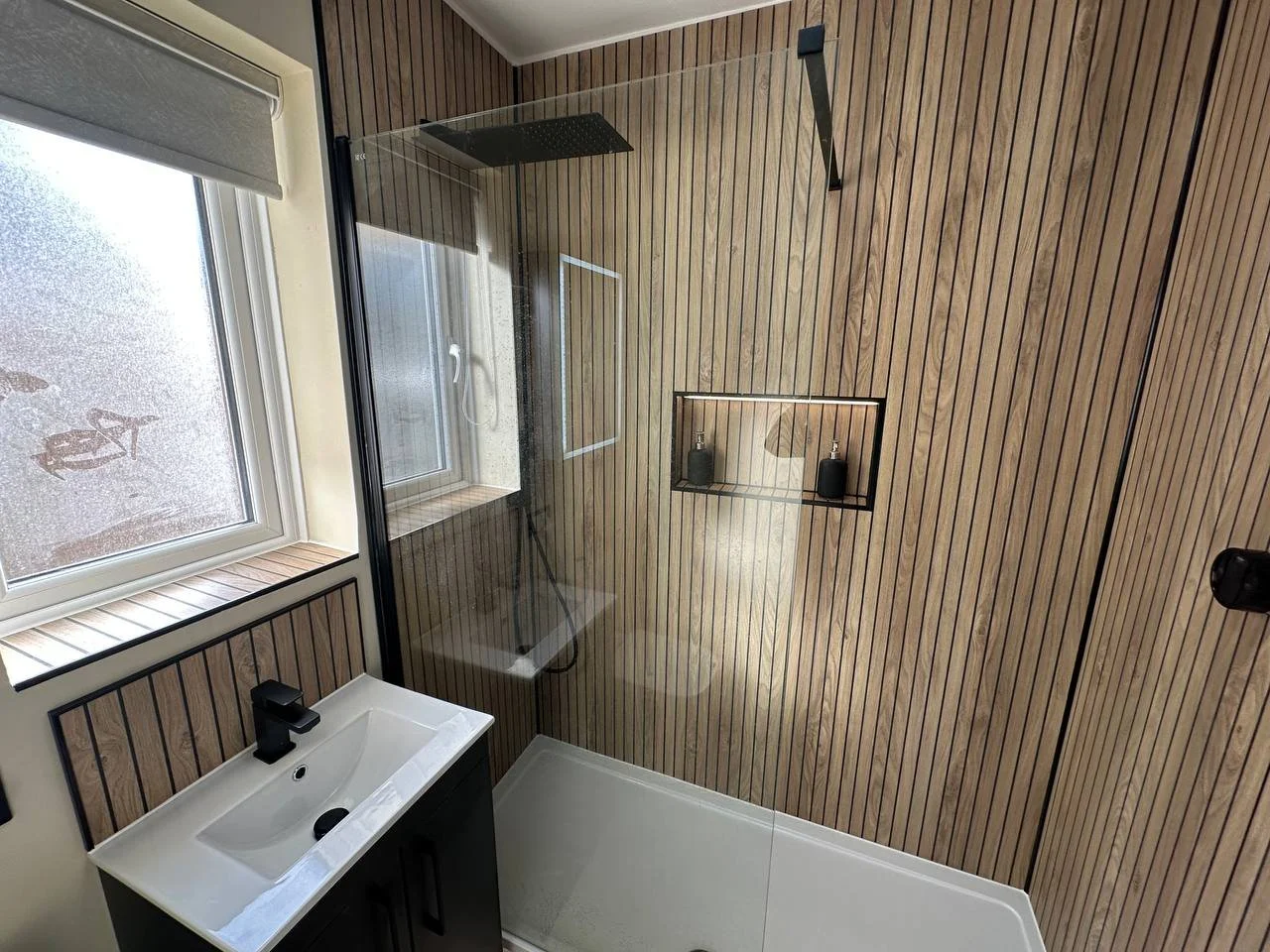
We recently used wooden wall panelling as part of a bathroom renovation in Oldfield Park, Bath, where it helped create a warmer and more contemporary finish.
The project also included LVT flooring, a modern concealed rain shower and LED lighting beneath the shower area.
It's a good example of how wall panelling can be used as part of a wider bathroom design rather than simply being treated as an alternative to tiles.
If you're looking for more inspiration, you can also see our completed bathroom renovation projects to get an idea of the different styles and finishes we've worked with.
Bathroom Wall Panels vs Tiles in a Shower
The shower is one of the most important areas to consider when choosing your wall finish.
It's exposed to more water than almost anywhere else in the bathroom, so waterproofing and installation are particularly important.
Both suitable bathroom wall panels and tiles can be used around shower areas.
With tiles, you have the familiar combination of tiles, grout and appropriate waterproofing.
With panels, the larger sections can provide a more continuous finish.
A concealed shower can work particularly well with larger wall panels because it keeps the overall appearance clean and uncluttered.
For either option, however, correct preparation and installation are essential.
This isn't an area where it's worth cutting corners.
What About Grout?
If you're considering bathroom wall panels because you're tired of cleaning grout, you're certainly not alone.
Grout is one of the areas of a tiled bathroom that can require the most regular attention.
Over time, it can become discoloured and may require more intensive cleaning.
Panels can reduce the amount of visible jointing considerably.
That can give you a cleaner-looking wall and potentially reduce the amount of routine cleaning required.
But panels aren't completely maintenance-free.
They still need to be cleaned and the seals around joints and edges should be kept in good condition.
Can You Mix Wall Panelling and Tiles?
Absolutely.
In fact, combining tiles and wall panelling can create a really interesting bathroom.
There's no rule saying your bathroom needs to be entirely tiled or entirely panelled.
You could have tiled flooring with wall panels.
You could use tiles around the basin and panels around the shower.
Or you could use a decorative tiled feature wall alongside more subtle wall panels.
Combining the two can give you the practical benefits of both materials while creating a more individual design.
It can also be useful if you've found a particular tile or panel that you really like but don't want to use throughout the entire room.
Which Is Better for a Small Bathroom?
For a small bathroom, both options can work very well.
The key is choosing the right design.
Large-format tiles can reduce the number of grout lines and create a more continuous appearance.
Similarly, larger wall panels can create fewer visual breaks.
Light colours can help reflect light, while a consistent finish across the walls can make the room feel less visually cluttered.
If you're working with a particularly small bathroom, it's worth considering the whole room rather than simply asking whether tiles or panels are better.
The layout, lighting, flooring, storage and bathroom fittings can all have a major effect on how spacious the room feels.
In some cases, removing an unused bath and replacing it with a shower can make a much bigger difference to the room than the choice between tiles and panels.
What About Bathroom Flooring?
It's easy to concentrate so much on the walls that the floor gets overlooked.
But your wall and floor finishes need to work together.
For example, if you've chosen a heavily patterned wall panel, you might want to keep the flooring relatively simple.
Alternatively, a plain wall finish could work well with a more distinctive floor.
LVT flooring is another option worth considering for bathroom renovations, with a wide range of colours, textures and designs available.
The important thing is to create a bathroom where all the different surfaces complement one another.
You don't necessarily want the walls, floor and fittings all competing for attention.
Should You Choose Bathroom Wall Panelling or Tiles?
So, after looking at the different options, which should you choose?
The answer depends on what matters most to you.
Choose wall panelling if you want:
A more continuous wall finish
Less visible grout
Easier day-to-day cleaning
A wide range of contemporary styles
Wood-effect or decorative finishes
A potentially quicker installation
A warmer alternative to a fully tiled bathroom
Choose tiles if you want:
A traditional bathroom finish
An enormous choice of sizes and designs
A highly durable surface
Intricate patterns or decorative layouts
A classic appearance
The ability to create detailed feature areas
And remember, you don't necessarily have to choose one or the other.
Combining tiles and panels can sometimes give you the best of both worlds.
The Importance of Professional Bathroom Installation
Whichever finish you choose, the quality of the installation matters.
Bathroom renovations involve much more than simply putting new products into a room.
Walls may need preparation.
Old fittings may need removing.
Plumbing and electrical work may be required.
Floors may need levelling or replacing.
And everything needs to be properly sealed and finished.
This is particularly important around wet areas such as showers and baths.
A beautifully designed bathroom can quickly develop problems if the preparation or installation isn't done properly.
At Bristol City Kitchens & Bathrooms, our complete bathroom renovation service brings together the different parts of the project, including plumbing, electrics, tiling and installation.
Choosing the Right Finish for Your Bathroom
There's no universal answer to the question of bathroom wall panelling vs tiles.
For some bathrooms, traditional tiles will always be the right choice.
For others, wall panelling can provide a cleaner, warmer and more contemporary finish.
And for many homeowners, the best solution could be a combination of the two.
The important thing is to think about how you'll actually use the bathroom.
Do you want something that's easy to clean?
Are you looking for a traditional or contemporary style?
Do you want to introduce natural-looking finishes?
How much maintenance are you prepared to do?
And what works with the size and layout of your room?
Once you answer those questions, the right option often becomes much clearer.
Planning a Bathroom Renovation?
If you're thinking about updating your bathroom, choosing between tiles and wall panels is just one part of the process.
The layout, plumbing, lighting, flooring, storage, shower, basin and other fittings all need to work together.
At Bristol City Kitchens & Bathrooms, we can help you look at the bathroom as a complete project rather than a collection of individual products.
Whether you're considering a complete bathroom refurbishment or simply want to update an existing space, careful planning can make a huge difference to the finished result.
If you're planning a bathroom renovation in Bristol or the surrounding area, get in touch to discuss what you'd like to achieve.
The best bathroom isn't necessarily the one with the most expensive tiles or the latest fittings.
It's the one that's been designed around you, your home and the way you use it.
